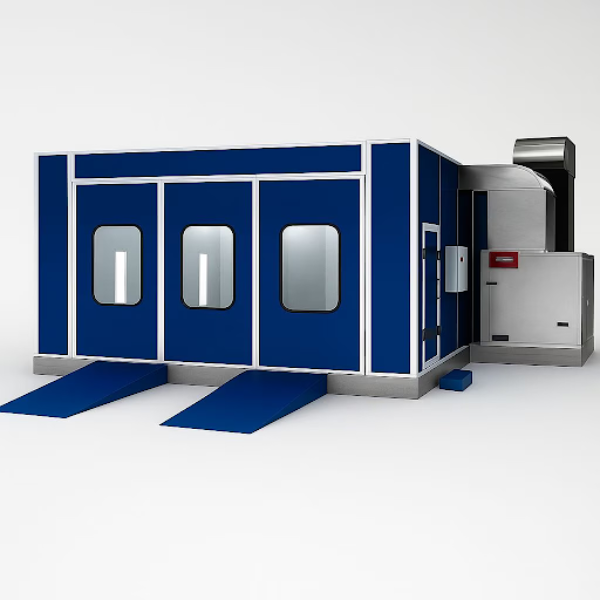
Automotive refinishing requires more than skilled spray application. Airflow, filtration, lighting, cleanliness, temperature conditions, and workspace organisation all influence the working environment. A properly planned paint booth creates a dedicated area for vehicle refinishing operations.
For workshops in Zirakpur considering body repair and painting services, understanding how a paint booth functions is important before deciding on its size or configuration.
Why Use a Dedicated Paint Booth?
Painting a vehicle in an uncontrolled workshop area can expose the process to dust, airborne particles, inconsistent airflow, and contamination from nearby repair activities.
A paint booth separates refinishing work from general mechanical operations and provides a more controlled environment.
Depending on its design, a booth may incorporate:
- Filtered air intake
- Exhaust system
- Lighting
- Air movement controls
- Heating or drying arrangements
- Floor or wall filtration
- Control panel
- Dedicated access doors
The exact configuration depends on the intended application and equipment design.
Airflow Is Central to Booth Performance
Air movement helps manage overspray and airborne contaminants generated during painting.
Different booth configurations manage airflow in different ways. Workshop owners should understand how air enters the booth, moves around the vehicle, and exits through the filtration system.
The appropriate design depends on factors such as vehicle size, refinishing volume, available space, building configuration, and applicable safety requirements.
Filtration Requires Ongoing Attention
Filters are not permanent components.
As filters collect contaminants, their condition can influence airflow and booth operation. Maintenance schedules should therefore include inspection and replacement according to equipment recommendations and actual usage.
Ignoring filtration until visible problems appear is poor workshop practice.
Lighting Affects Refinishing Work
Painters need adequate visibility to inspect surfaces, identify coverage differences, and work consistently across vehicle panels.
Lighting should be considered as part of booth design rather than an afterthought.
Placement is important because shadows and uneven illumination can make surface assessment more difficult.
Space Planning Begins Before Installation
A paint booth occupies considerably more than the dimensions of the vehicle itself.
Workshop owners need to account for equipment structure, access, ducting, exhaust arrangements, service clearances, vehicle movement, preparation areas, and surrounding workflow.
In Zirakpur, where automotive businesses may operate from properties with varying floor dimensions and access conditions, a site assessment can help identify practical installation constraints early.
Safety Cannot Be Treated as Optional
Automotive refinishing involves paints, solvents, vapours, electrical equipment, and potentially combustible materials.
Paint booth design, installation, ventilation, electrical systems, fire-safety provisions, operating procedures, and personal protective equipment should comply with applicable requirements and manufacturer guidance.
Technicians should also receive appropriate training before operating the facility.
Think Beyond the Booth Purchase
Aarya Automative Solutions works with automotive businesses requiring garage and workshop equipment in Zirakpur and across Punjab. Workshops evaluating a paint booth should consider vehicle dimensions, expected refinishing volume, available space, electrical requirements, ventilation arrangements, installation needs, maintenance access, and technical support.
A paint booth should be viewed as part of a complete refinishing process. Preparation, spraying, drying, cleaning, maintenance, and safety practices all influence the quality and efficiency of body-shop operations.
Keywords